



Practical Experience in Deploying FDI Solar Projects: A Real-World Guide in Vietnam
Foreign direct investment (FDI) investors implementing solar power projects in Vietnam often face a critical challenge: How can they select an EPC contractor with real, proven execution experience — not just “on paper”? This is a common question raised by many foreign enterprises entering Vietnam’s renewable energy market.
This article analyzes hands-on implementation experience, details a 6-step EPC delivery process, outlines legal and regulatory compliance requirements in Vietnam, and provides practical guidance for evaluating EPC contractors based on key criteria. You will find: the end-to-end deployment process from site survey to operation, a contractor evaluation checklist, and the essential legal requirements applicable to FDI solar projects.
What Is Contractor Experience in FDI Solar Projects?
Internationally Accepted Definition
Contractor experience refers to a capability profile demonstrating that an EPC contractor has successfully delivered comparable solar power projects. For FDI projects in Vietnam, qualified contractor experience typically includes:
-
Long-term experience in the renewable energy sector
-
A substantial total installed and commissioned capacity
-
A project portfolio serving both domestic and international clients
-
International certifications: ISO 9001, ISO 14001, ISO 45001
-
Documentary evidence: commissioning records, site photos, acceptance certificates
According to standards issued by the International Finance Corporation (IFC) of the World Bank Group, EPC contractors for renewable energy projects must demonstrate experience through completed projects of comparable scale. This requirement is especially critical for FDI projects, where expectations for quality, compliance, and international standards are significantly higher.
The difference between domestic and international standards lies primarily in the level of documentation detail. While domestic projects may accept Vietnamese-language documentation, many FDI corporations require technical documents and contracts in English, often accompanied by ESG reports aligned with GRI standards, depending on the parent company’s internal policies, along with compliance with international safety standards.
Why Must FDI Investors Rigorously Evaluate Contractor Experience?
Minimizing Legal and Compliance Risks
Inexperienced contractors often lack a clear understanding of environmental approval procedures (EIA), Vietnam Electricity (EVN) grid connection approvals, and investment licensing requirements. This can result in severe project delays. In practice, many projects have encountered difficulties due to incomplete environmental documentation or procedural errors during the permitting phase.
Ensuring Committed System Performance
Experienced contractors are typically able to accurately forecast system performance based on real operational data. The Performance Ratio (PR) is a key indicator measuring actual operational efficiency against theoretical output. According to the International Energy Agency (IEA) and operational data across Southeast Asia, rooftop systems designed by experienced contractors commonly achieve a PR of approximately 80–85%.
Compliance with Corporate ESG Standards
Most large FDI corporations enforce strict ESG (Environmental, Social, Governance) requirements and maintain renewable energy usage policies. Many corporations choose to use I-REC (International Renewable Energy Certificate) as a tool to verify green electricity consumption. EPC contractors must therefore have experience preparing ESG documentation aligned with international standards.
Optimizing Long-Term Operating Costs
Correct equipment selection from the outset significantly reduces Operation & Maintenance (O&M) costs over the system’s lifecycle. Tier-1 modules from Trina Solar, Canadian Solar, JA Solar, and LONGi Solar typically offer long-term warranties and stable performance degradation profiles.
Six Mandatory Criteria for Evaluating Contractor Experience

Overview of the Six Criteria
To comprehensively assess EPC contractor capability, FDI enterprises should evaluate the following six core criteria:
| Criterion | Weight | Verification Method |
|---|---|---|
| Years of Experience | 15% | Business license, company profile |
| Total Installed Capacity | 20% | Project portfolio, commissioning records |
| Number of FDI Projects | 25% | Client list, site visits |
| International Certifications | 15% | Certificate copies, audit reports |
| Financial Stability | 10% | Financial statements, bank guarantees |
| After-Sales Support & O&M | 15% | Warranty terms, response-time commitments |
Criterion 1 — Years of Experience
Long-term experience in the solar energy sector is critical, as Vietnam’s solar market has undergone multiple policy cycles. The market expanded rapidly from 2017 under the Feed-in Tariff (FIT) scheme, then transitioned to alternative models such as Direct PPA and self-consumption systems.
Warning signs to avoid:
-
Newly established companies claiming extensive historical experience
-
Experience concentrated mainly in civil construction rather than solar EPC
Effective verification methods:
-
Request business licenses and time-sequenced project portfolios
-
Cross-check company information via the Vietnam Chamber of Commerce and Industry (VCCI)
Criterion 2 — Total Installed Capacity
Total installed capacity reflects both operational scale and accumulated technical experience. Contractors with large installed capacities typically enjoy stronger bargaining power with equipment manufacturers and broader exposure to diverse project types.
Verification methods:
-
Request a project list with commissioning dates
-
Cross-check with EVN grid connection approval records (for on-grid projects)
-
Conduct site visits to completed projects to assess build quality
Criterion 3 — Number of FDI Projects
FDI solar projects differ significantly from domestic projects. First, there are documentation requirements — all technical documents, contracts, and reports must be prepared in English and aligned with international standards. Second, FDI enterprises often require detailed ESG reporting to be submitted to the parent company.
Common FDI client groups in Vietnam include:
-
Japan: Electronics and manufacturing companies
-
South Korea: Technology and textile conglomerates
-
United States: High-tech enterprises
-
Europe: Retail and manufacturing corporations
Warning signs:
-
Client portfolios consisting primarily of Vietnamese companies
-
No references or testimonials from FDI clients
Verification methods:
-
Request a client list with contact information
-
Directly contact FDI clients for references (where permitted)
Criterion 4 — International Certifications
ISO certifications and international standards reflect the contractor’s quality management system.
Required / commonly requested certifications:
-
ISO 9001:2015 — Quality management system
-
ISO 14001:2015 — Environmental management
-
ISO 45001:2018 — Occupational health and safety
Recommended certifications:
-
IEC 61730 — Safety qualification for photovoltaic modules
-
TCVN 10896:2015 — National standard for ground-mounted thin-film photovoltaic (PV) modules, used to evaluate design quality and type approval
Verification methods:
-
Request certificate copies with validity dates
-
Verify certificates via the issuing body’s official website
Criterion 5 — Financial Stability

Strong financial health ensures that the contractor has sufficient resources to complete the project. Solar EPC projects typically involve milestone-based payment mechanisms, and financially weak contractors may struggle with advance funding.
Key financial indicators to assess:
-
Stable annual revenue
-
Reasonable debt-to-equity ratio
-
Positive net profit
Verification methods:
-
Request audited financial statements for the last three years
-
Obtain bank confirmation letters
-
Require performance bonds issued by banks
Criterion 6 — After-Sales Support & O&M
Long-term support commitments clearly differentiate professional EPC contractors from opportunistic ones.
Minimum requirements:
-
Construction warranty: Typically 2 years
-
Equipment warranty: Per manufacturer (inverters usually 10 years; modules usually 25 years)
-
Performance warranty: Guaranteed Performance Ratio
-
Response time: Clearly defined for different incident types
-
O&M team: Dedicated technical personnel
Warning signs:
-
Warranty periods shorter than industry standards
-
No dedicated O&M contract
-
Full outsourcing of maintenance services
International-Standard EPC Process: Detailed 6-Step Framework
Process Overview
A standard EPC (Engineering, Procurement, Construction) process for solar projects typically spans 4–6 months, including:
-
Steps 1–2 (Survey + Design): 4–6 weeks
-
Step 3 (Permitting): 3–4 weeks
-
Step 4 (Procurement): 4–6 weeks
-
Step 5 (Construction): 8–12 weeks
-
Step 6 (Commissioning): 1–2 weeks
Step 1 — Site Survey & Feasibility Study (2 Weeks)
The objective of this phase is to assess technical and financial feasibility.
Key activities:
1.1. Site assessment
Engineering teams conduct site surveys, including roof structure inspections, measurement of usable installation areas, analysis of electricity bills to understand consumption demand, and evaluation of EVN grid connectivity.
1.2. Shading analysis
Use specialized software such as PVsyst, a widely adopted simulation tool in the solar industry and consistent with international engineering practices.
1.3. Financial modeling
Estimate capital expenditure (CAPEX), operating expenditure (OPEX), forecast electricity savings or sales revenue, calculate the payback period, NPV, IRR, and perform sensitivity analysis.
1.4. Risk assessment
Identify technical, legal, and financial risks.
Deliverable: Feasibility report with a detailed financial model.
Step 2 — Engineering Design & Technical Development (2 Weeks)
2.1. System design
Module layout on the roof, string configuration, and equipment selection from reputable brands (Trina Solar, JA Solar, Canadian Solar, LONGi for modules; Sungrow, Huawei, SMA for inverters).
2.2. Electrical design
Single-line diagrams, cable sizing calculations, and design of protection devices and grounding systems.
2.3. Structural design
Calculation of mounting structure based on wind and seismic loads in accordance with Vietnamese standards.
2.4. 3D visualization
Create simulation visuals for client presentation.
Deliverable: Construction drawings, bill of quantities, and equipment technical specifications.
Step 3 — Permits & Legal Compliance (3–4 Weeks)
This is a critical step to ensure compliance with Vietnamese regulations.
3.1. Investment license (for FDI projects)
For rooftop systems installed on factories owned by the FDI enterprise and used for self-consumption, a new investment license is generally not required.
Only when the enterprise intends to sell electricity or operate energy services may it be necessary to consider adding appropriate business lines.
3.2. Environmental compliance
-
For self-consumption rooftop systems, an Environmental Protection Commitment is typically sufficient.
-
Grid-connected projects with capacity exceeding 3 MWp may require an Environmental Impact Assessment (EIA) in accordance with the Law on Environmental Protection 2020 and Decree 08/2022/NĐ-CP, subject to guidance from the local Department of Natural Resources and Environment.
3.3. Construction permit
Most rooftop solar systems do not require a construction permit unless structural modifications affect the building’s load-bearing structure.
3.4. Grid connection approval
Submit documentation to EVN for grid connection approval (if electricity is sold).
3.5. Other permits
Solar equipment is freely importable and does not require an import license.
Only standard customs documents are required, including CO, CQ, invoice, packing list, and technical specifications.
Deliverable: A complete permit and approval dossier in compliance with regulations.
Step 4 — Equipment Procurement (4–6 Weeks)
4.1. Supplier sourcing
Issue requests for quotation (RFQs) to multiple suppliers and conduct both technical and commercial evaluations.
4.2. Purchase orders
Release purchase orders with milestone-based payment terms.
4.3. Logistics
Manage international transportation, customs clearance, and delivery to the construction site.
4.4. Quality inspection
Inspect equipment upon delivery for quantity, quality, and documentation compliance.
Deliverable: Procurement log and delivery acceptance records.
Step 5 — Construction & Installation (8–12 Weeks)
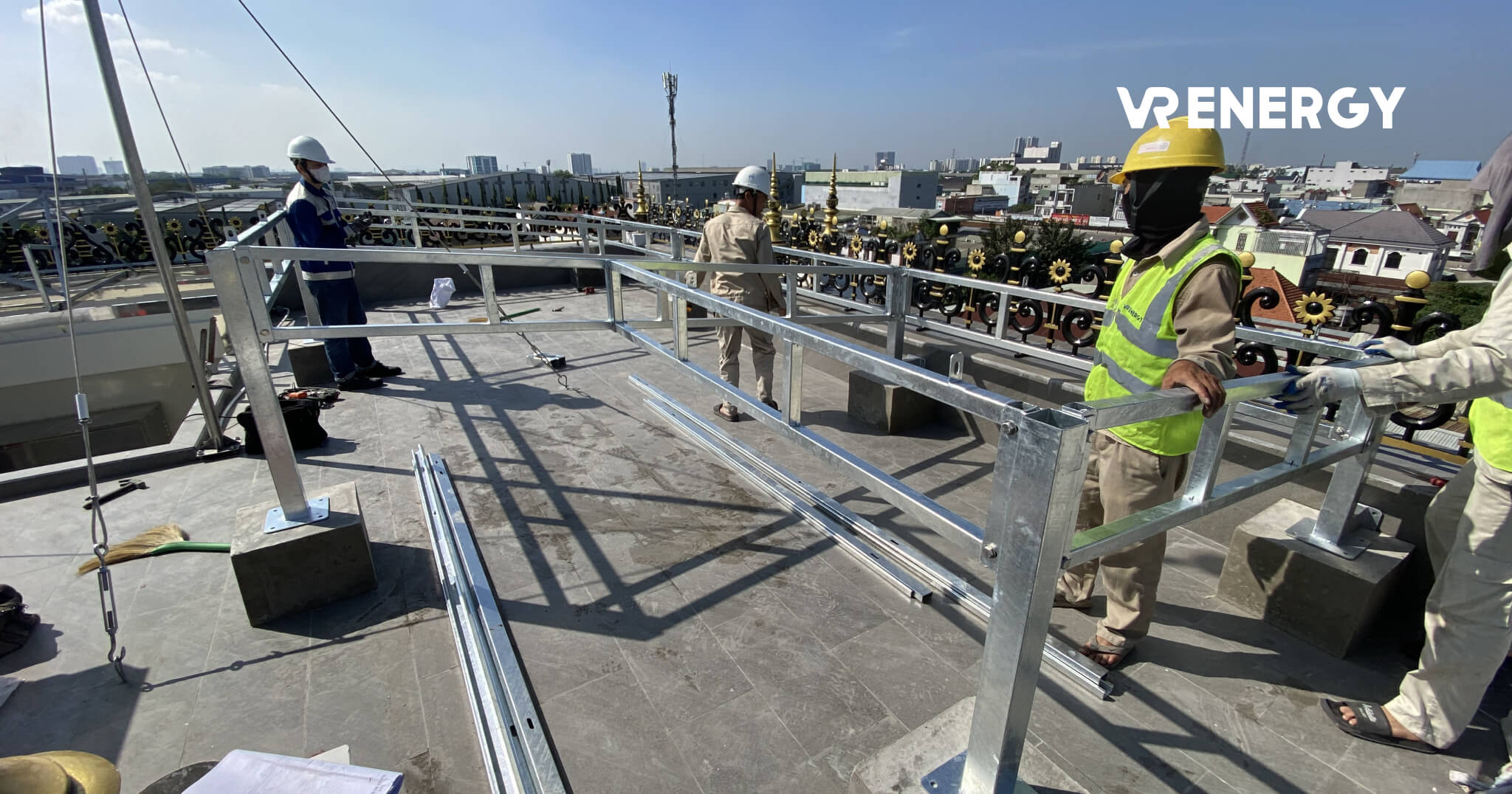
5.1. Resource mobilization
Set up site offices, prepare tools and equipment, and conduct occupational safety training.
5.2. Mounting structure installation
Prepare the roof and install rails and module mounting structures.
5.3. Module installation
Install modules according to design; perform DC connections and ensure proper cable management.
5.4. Electrical works
Install inverters, route AC cabling, install protection devices, and complete grounding systems.
5.5. System integration
Configure the monitoring system (if applicable).
Deliverable: Progress reports and site photographs.
Step 6 — Testing, Commissioning & Handover (1–2 Weeks)
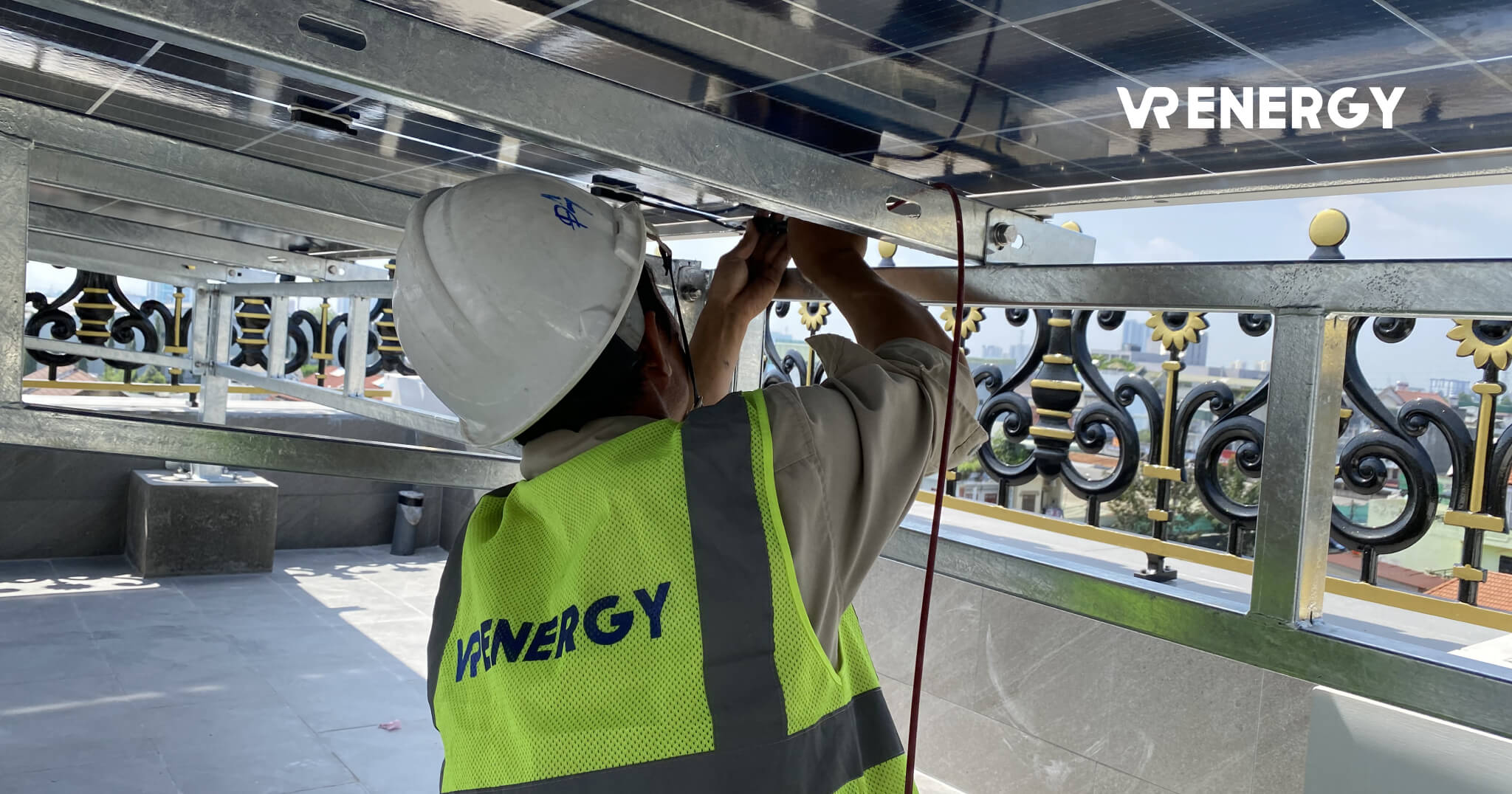
6.1. Pre-commissioning checks
Visual inspection, insulation resistance testing, grounding continuity testing, and polarity checks.
6.2. Trial operation
Start up inverters, verify grid connection, check performance, and validate the monitoring system.
6.3. Performance verification
Operate the system under real conditions, measure energy output, and compare results against design simulations.
6.4. Training & handover
Provide operational training to client staff and hand over complete documentation, including as-built drawings, O&M manuals, and warranty certificates.
Contractor Selection Roadmap for FDI Enterprises
After understanding the evaluation criteria and EPC process, FDI enterprises can apply the following roadmap:
Phase 1 — Shortlisting (2 weeks)
Identify potential contractors through partner referrals, online research, and industry conferences. Conduct initial screening based on websites, portfolios, and client reviews.
Phase 2 — Detailed evaluation (4–6 weeks)
Issue Requests for Information (RFI), request project lists and references. Conduct reference checks, site visits, and apply a scoring matrix for evaluation.
Phase 3 — Negotiation (2–3 weeks)
Select the highest-scoring contractor for detailed negotiations on payment terms, warranties, schedule commitments, and delay penalties. Engage legal counsel to review the EPC contract.
Phase 4 — Contract execution & kickoff (1 week)
Sign the EPC contract, establish communication channels and reporting mechanisms, and conduct the project kickoff meeting.
Key Considerations
Compliance with Vietnamese Standards

Solar projects in Vietnam must comply with:
-
TCVN 10896:2015 — National standard for ground-mounted thin-film photovoltaic (PV) modules, used to evaluate design quality and type approval
-
QCVN 32:2015 — Applicable to projects connected to the EVN grid (self-consumption rooftop systems are generally outside this scope)
-
Construction Law 2014 and related decrees
-
Solar projects commonly apply Construction All Risks (CAR) insurance and third-party liability insurance in accordance with Circular 329/2016/TT-BTC
Selection of High-Quality Equipment
Priority should be given to Tier-1 equipment brands, including:
-
PV modules: Trina Solar, JA Solar, Canadian Solar, LONGi Solar
-
Inverters: Sungrow, Huawei, SMA, Fronius
These brands offer long-term warranties and are widely recognized by international financial institutions, according to rankings published by Bloomberg New Energy Finance (BNEF).
Project Risk Management
Technical risks:
-
Insufficient roof load-bearing capacity
-
Shading from surrounding structures
-
Substandard equipment quality
Legal risks:
-
Delays in permitting
-
Non-compliance with environmental regulations
-
Contractual disputes
Financial risks:
-
Exchange rate fluctuations
-
Unforeseen cost overruns
-
Contractor financial distress
System Performance Optimization
To achieve optimal performance:
-
Perform accurate design using specialized software
-
Select appropriate tilt angles and orientations
-
Minimize shading losses
-
Conduct periodic maintenance and module cleaning
-
Monitor system performance continuously
Investing sufficient time and effort in the initial contractor selection phase helps enterprises avoid many downstream risks during project execution. Making the right decision from the outset forms the foundation for a successful solar project and long-term economic benefits.
About VRenergy
With extensive experience in delivering renewable energy projects in Vietnam, VRenergy provides comprehensive solar solutions ranging from consulting and design to construction and operation & maintenance. We are committed to complying with international standards and delivering professional service quality to both domestic and international enterprises.
Advisory Contact:
For detailed consultation on solar solutions tailored to your enterprise’s needs, please contact the VRenergy expert team. We are ready to support feasibility assessment, preliminary design, and project planning.


 Xem thêm







