


The installation of a solar power system requires thorough research on location, tilt angle, and surrounding environmental conditions to optimize efficiency. One often underestimated but significantly impactful factor is shading. Trees, tall buildings, and even small objects like antenna poles or fallen leaves can partially obscure the solar panels, leading to reduced efficiency and electricity production loss. So why does shading have such a significant impact on solar power systems? And how can we minimize this negative effect? The following article will provide detailed analysis to help you better understand this important issue.
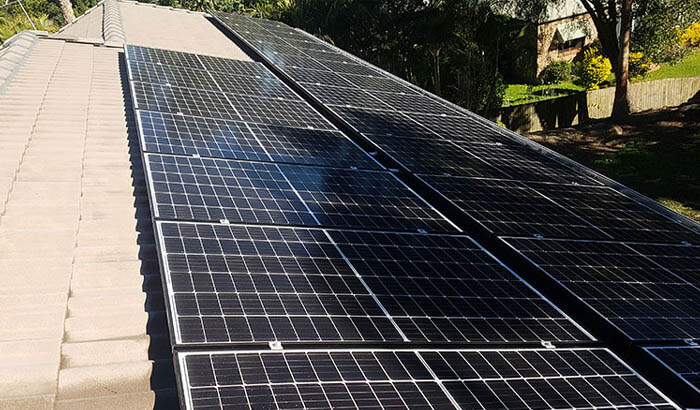
Why shading affects the efficiency of solar power systems
Solar power systems operate based on the photovoltaic effect, where photovoltaic (PV) cells absorb sunlight, stimulating electrons to generate electric current. These cells are connected in series within a panel to increase voltage. However, due to the principle of electrical circuit operation, the current within the panel must be uniform throughout the entire chain. This means that if one cell is shaded, the generated power decreases and limits the current of the entire panel to the lowest level of the shaded cell. As a result, the overall system performance drops significantly.
For instance, in a panel comprising 36 cells, if just one cell is completely shaded, it can cause the entire panel to stop working if there is no proper protective measure. Some studies indicate that even if only one cell is shaded, the panel’s power output can decrease by 50% to 80%, depending on the degree of coverage and the distribution of shading on the panel’s surface.
Types of shading and their impact on performance
Shading affects the efficiency of solar power systems in various ways, depending on how it covers the panel’s surface. There are two main types of shading:
- Uniform shading: Occurs when the entire panel is covered, such as during cloudy weather. In this case, the panel’s power output decreases in proportion to the amount of light blocked. However, the impact is not as severe as non-uniform shading.
- Non-uniform shading: This has a greater impact and occurs when only part of the panel is shaded, usually due to obstacles like tree branches, chimneys, or surrounding buildings. In such cases, the current in the series chain becomes unbalanced, significantly reducing operational efficiency.
Not only does it reduce power output, but shading can also cause hot spots. When a cell is shaded but still receives current from other cells, it can become overloaded and overheat, eventually damaging the panel. Therefore, designing the system properly to avoid shading is crucial to enhance efficiency and extend the lifespan of the solar power system.

Solutions to minimize shading impact
Shading can significantly affect the efficiency of solar power systems, so proper design and installation from the beginning are key factors. First, a field survey is needed to identify objects that may create shadows, such as trees, tall buildings, or even chimneys. From there, the position and tilt angle of the panels will be adjusted to match the local lighting conditions. In the Northern Hemisphere, the South-facing direction is ideal to optimize energy absorption. Additionally, arranging panel strings (stringing arrangements) by grouping panels with similar shading levels helps minimize the overall efficiency impact.
Technology applications
Technological advancements today offer many solutions to reduce the impact of shading on solar power systems. For instance, bypass diodes can allow current to flow through shaded areas; however, if the shading is too extensive, efficiency still decreases. A more optimal option is to use DC optimizers or microinverters, which allow each panel to operate independently, ensuring that the output is not significantly affected by other panels. Additionally, half-cell technology is becoming increasingly popular due to its ability to minimize the effects of local shading, helping the system maintain stable operation.
System maintenance and management
Besides proper installation, regular maintenance is also an important factor to mitigate shading issues. Panels may be covered by dirt, bird droppings, or fallen leaves, reducing light absorption efficiency. Therefore, periodic cleaning is necessary to keep the photovoltaic surface clear. Furthermore, if the installation area has surrounding greenery, regular pruning will help reduce shading changes over time, especially as trees grow larger.

Shading can reduce the efficiency of solar power systems, but with proper design and operation, these negative impacts can be significantly mitigated. It is crucial for investors and engineers to carefully calculate from the design stage, choose appropriate technology, and apply advanced technical solutions. When correctly implemented, solar power not only brings economic benefits but also contributes to sustainable development goals, reducing reliance on fossil fuels and protecting the environment.


 Xem thêm








